 PRECISION
The steel tool creates a flexible silicone tray, which then works with a filling and release process. Keep those two manufacturing stages separate when specifying portion targets, handling and surface acceptance.
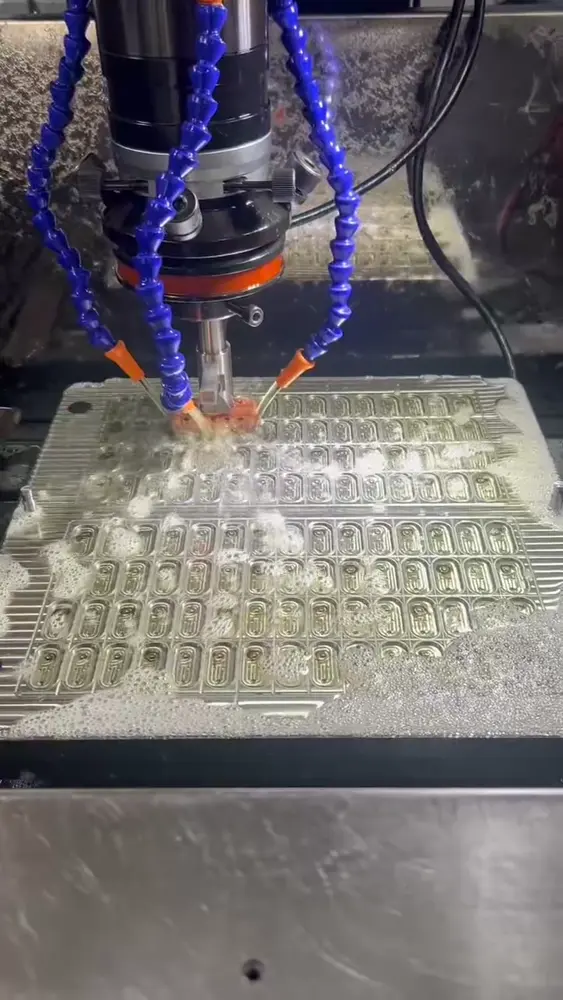
Keep these references together
- Filled handling
- Cavity details
- Application trial
Use one approved revision for the quotation, tool design and sample review. Record exceptions explicitly when a trial leaves a requirement unresolved.
How do I plan cavity layout for a custom silicone gummy tray?
Start with product shape, target portion, tray handling and available production equipment. Cavity count is only one part of the system; spacing and tray stiffness affect use.
Provide the finished piece target and how the filled tray is handled.
Decision to agree: Validate the complete tray in its intended filling and release workflow.
Back to the questions ↑Can a steel tool control the final weight of a cast gummy?
The tool controls silicone tray geometry, while the cast product also depends on fill level and formulation. A cavity-volume estimate is not a guarantee of final food weight.
Provide density or actual fill trials and the intended fill reference.
Decision to agree: Approve portion performance using the customer's real material and process.
Back to the questions ↑Why does a large silicone tray sag when filled?
Sag depends on tray geometry, material, load and support. A tool reproduces the approved design; it cannot make an unsupported flexible tray rigid by machining accuracy alone.
Provide filled weight, handling span and support conditions.
Decision to agree: Review backing or geometry changes before production tooling is frozen.
Back to the questions ↑How can I keep cavity depth consistent across a silicone tray?
Review the tool geometry and the molded tray's inspection support. A flexible tray measured unevenly on a bench can produce misleading depth differences.
Specify how the tray is supported during measurement.
Decision to agree: Validate depth and use performance across the complete layout.
Back to the questions ↑Can a chocolate mold logo be sharp without trapping the product?
Fine detail must be balanced with release and the actual casting material. The geometry of the silicone tray and its production tool should be reviewed at product scale.
Provide artwork and an example of the cast surface required.
Decision to agree: Test release and legibility with the customer's formulation before scaling.
Back to the questions ↑What changes when scaling a silicone tray from 10 to 50 cavities?
The overall structure, support, loading and release effort change along with capacity. Simply repeating the cavity pattern may not produce a practical tray.
Provide equipment envelope, filled weight and operator handling method.
Decision to agree: Approve the full-size tray rather than relying solely on a small-cavity prototype.
Back to the questions ↑How do I specify a food tray's smooth cavity surface?
Define the surface reference and cleaning expectations separately from any documentation requirement. A smooth-looking image does not establish cleanability or food-contact suitability.
Mark the cavity faces and provide the actual use conditions.
Decision to agree: Approve the chosen compound documentation and physical finish through separate checks.
Back to the questions ↑Can the same tooling make silicone trays in different colors?
Color variants may be possible, but the compound system and production control must be reviewed. Color changeovers and contamination limits are operational questions as well as appearance questions.
List the colors, approved references and order quantities.
Decision to agree: Confirm material equivalence and appearance approval for each variant.
Back to the questions ↑Why does a silicone tray warp after cooling or post-cure?
Compare geometry, material, processing and support through the complete route. A flat cavity plate does not by itself guarantee that a large flexible tray remains flat in every condition.
Record when the warp appears and how the tray is supported.
Decision to agree: Use representative trials to distinguish design and process causes.
Back to the questions ↑What should be tested before approving a production tool for silicone trays?
Check dimensions, cavity details, release, loaded handling and the agreed surface condition. Tests using an unrelated casting material may not represent the customer's application.
Provide the real filling and demolding procedure and approved part references.
Decision to agree: Approve performance of the finished tray as well as its production-tool geometry.
Back to the questions ↑Put the answers into your project
Use these questions to structure a discussion about your own drawing. Feasibility, price, tool life and acceptance depend on the agreed part, compound, equipment and verification scope. This guide provides planning questions rather than project-specific guarantees.
Explore the relevant tooling service →Open the procurement checklist · Browse the full knowledge center
Editorial method: AI-assisted drafting organized around buyer decisions and public process references. Review project-specific technical requirements with the responsible engineer. Sources and editorial approach.